


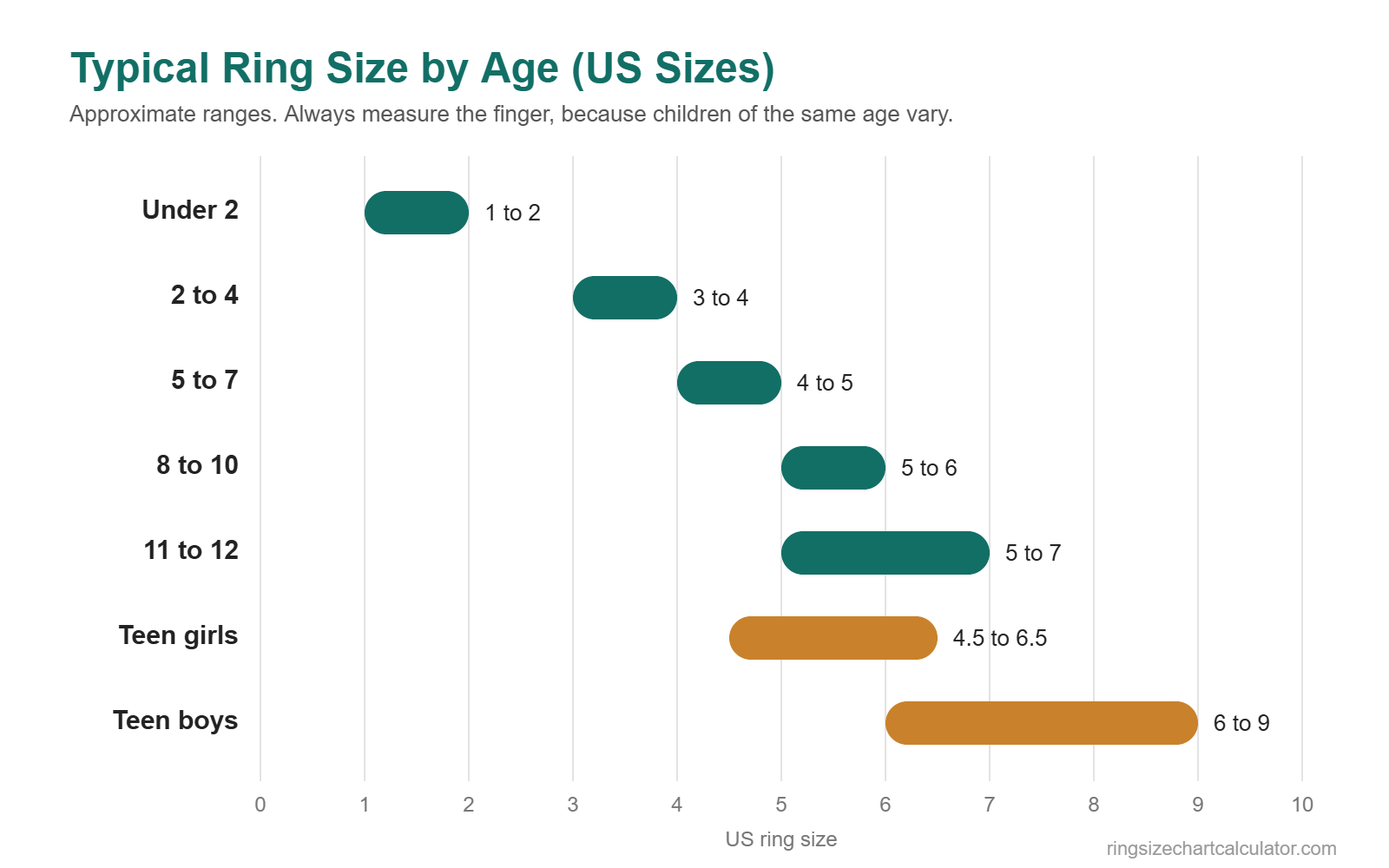
Most babies under 2 wear about a US size 1 to 2, children aged 2 to 4 wear about a size 3 to 4, ages 5 to 7 about a size 4 to 5, ages 8 to 10 about a size 5 to 6, and ages 11 to 12 about a size 5 to 7. Teen girls usually wear between a size 4.5 and 6.5, while teen boys usually wear between a size 6 and 9. These are only typical ranges, so the safest way to choose a ring for a child or teen is to measure the finger, then allow a little room for growth.
This guide gives a ring size chart by age, explains how to measure a child’s finger, and shares safety and buying tips for kids and teens.

Kids and Teens Ring Size Chart by Age
| Age | Typical US size | Inside diameter (mm) | Inside circumference (mm) |
|---|---|---|---|
| Under 2 years | 1 to 2 | 12.4 to 13.3 | 39.1 to 41.7 |
| 2 to 4 years | 3 to 4 | 14.1 to 14.9 | 44.2 to 46.8 |
| 5 to 7 years | 4 to 5 | 14.9 to 15.7 | 46.8 to 49.3 |
| 8 to 10 years | 5 to 6 | 15.7 to 16.5 | 49.3 to 51.9 |
| 11 to 12 years | 5 to 7 | 15.7 to 17.3 | 49.3 to 54.4 |
| Teen girls, 13 to 18 | 4.5 to 6.5 | 15.3 to 16.9 | 48.0 to 53.1 |
| Teen boys, 13 to 18 | 6 to 9 | 16.5 to 18.9 | 51.9 to 59.5 |
Children of the same age can differ by two or more sizes, so treat the chart as a starting point. To change a size into UK, EU or other systems, use our ring size conversion chart.
How to Measure a Child’s Ring Size
- Pick a calm moment. Small children wriggle, so measure while they are relaxed or distracted.
- Wrap a strip of paper or soft tape around the base of the finger the ring will be worn on. It should be snug but not tight. Our guide to measuring ring size with a fabric tape measure shows the method step by step.
- Mark where the strip overlaps and measure the length in millimeters. That number is the finger circumference.
- Check it passes the knuckle. Slide the loop over the knuckle. If it will not pass, go up half a size.
- Convert the number with our free ring size chart calculator.
- Measure twice on different days, ideally in the afternoon when fingers are at their usual size.
If your child already has a ring that fits, you can lay it on a printable ring sizer and read the size from the circles instead.
Ring Sizes for Teens
By the early teens, most fingers are close to adult size, although they can still grow until the late teens. Teen girls often wear a size 5 to 6, which is just under the adult average described in our guide to the average female ring size. Teen boys usually wear a size 7 to 8, and taller boys or those with larger hands may wear a size 9 or more.
If a ring is a gift and you cannot measure, these tips help:
- Borrow a ring they already wear and measure its inside diameter.
- Ask a parent, sibling or close friend who may know the size.
- Choose an adjustable or open band if you are unsure.
For more ideas, read how to find someone’s ring size secretly.
Safety Tips for Children’s Rings
- Rings are a choking risk for babies and toddlers. Small rings and loose stones can be swallowed, so many parents wait until a child is older before letting them wear rings, and supervise young children whenever they wear jewelry.
- Never leave a ring that is too tight. A child’s finger can swell, and a tight ring can cut off circulation. If a ring will not come off, use soap and a raised hand, and get medical help if the finger turns pale, blue or very painful.
- Take rings off for sleep, sport and swimming. This lowers the chance of injury and loss.
- Choose smooth, lightweight designs with no sharp prongs or loose parts.
- Pick skin friendly metals such as sterling silver, solid gold or titanium, especially for children with sensitive skin.
Buying Tips for Growing Fingers
- Allow room for growth. For young children, choosing half a size larger than the measured size helps a ring last longer, as long as it does not slip off easily.
- Choose adjustable rings for young kids. Open and expandable bands can be widened as the finger grows.
- Prefer plain bands for keepsakes. Simple gold and silver bands are the easiest to resize later. A jeweler can usually make them a little bigger or smaller.
- Recheck the size often. Young children’s fingers can change size within a year, so measure again before buying a new ring.
Frequently Asked Questions
What ring size is a 10 year old?
Most 10 year olds wear about a US size 5 to 6, but it varies, so measuring the finger is the most reliable way to know.
What ring size is a 13 year old?
Most 13 year old girls wear about a size 4.5 to 6, and most 13 year old boys wear about a size 6 to 8.
What is the smallest ring size?
Baby rings often start at about a US size 1, with an inside diameter of about 12.4 mm. Some brands make even smaller sizes for newborns.
Should I buy a bigger ring for a child to grow into?
Half a size larger is usually fine. A ring that is much too big can fall off and be lost or swallowed, so avoid going more than half a size up.
Is it safe for toddlers to wear rings?
Rings can be a choking hazard for babies and toddlers. If a young child wears a ring, choose a secure, smooth design and keep them supervised.
Final Thoughts
Ring sizes for kids and teens follow a rough pattern by age, from about a size 1 for babies to a size 6 to 9 for teen boys. Because children grow at different speeds, always measure the finger, allow a little room for growth and choose safe, simple designs. Measure again before every new ring, and use the chart above as a helpful guide rather than a rule.
